This film is playing live in the theater.
Members watch in sync with everyone inside. Membership is free during early access.
La inviolabilidad del domicilio
2011
·
7 min
·
digital
·
Thriller / Short
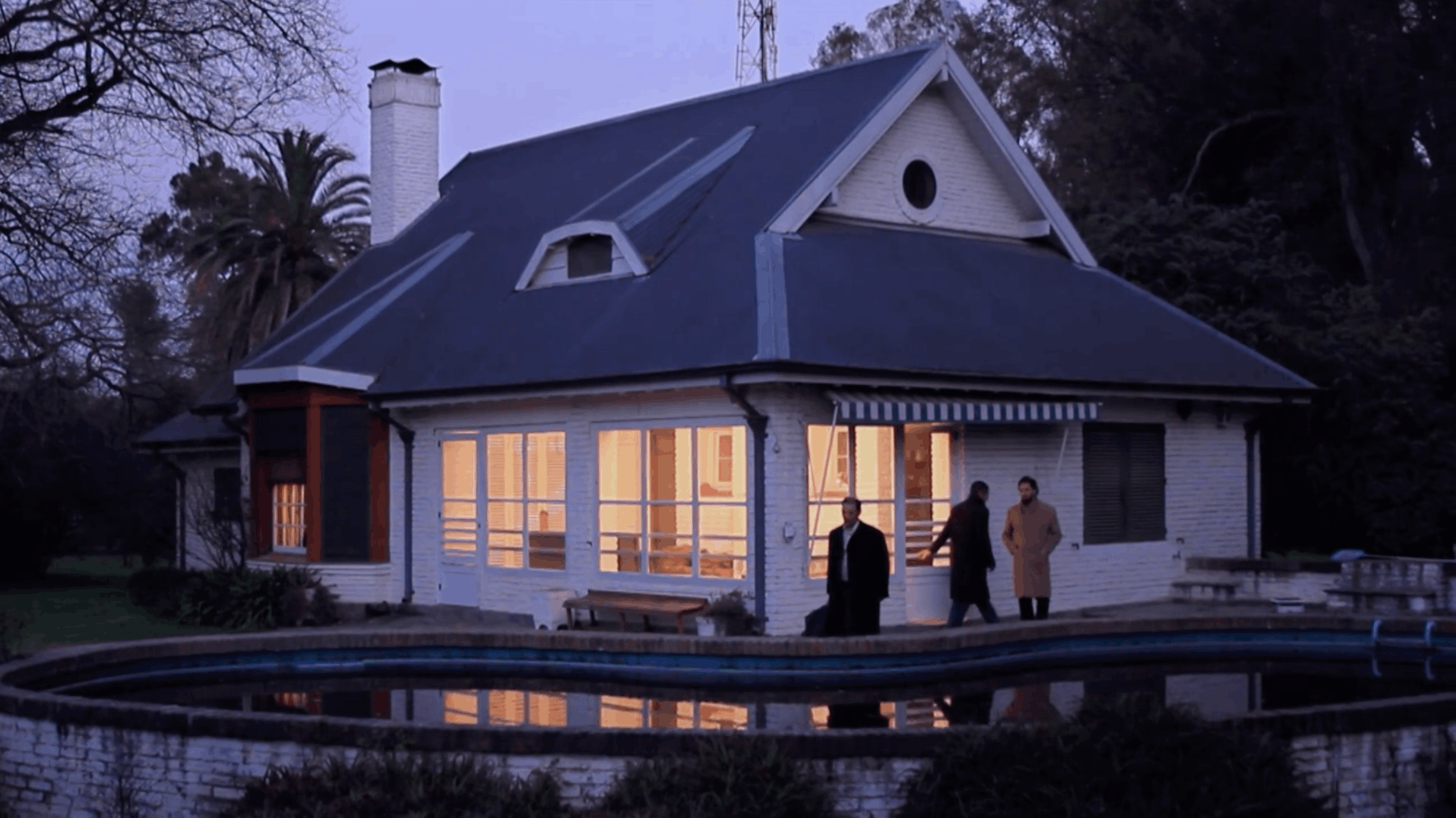
At the garden of a provincial summer house, a series of operations is carried out, involving a man, a woman and a group of individuals with certain convictions. At the garden of a provincial summer house, a series of operations is carried out, involving a man, a woman and a group of individuals with certain convictions.
Director
Alex Piperno
Writer
Alex Piperno
Crew
Cinematography
·
Sergio Claudio
·
Sound
·
Lucas Larriera
TimeSink Presents
Film Review
The title, translated as “The inviolability of the home is based on the man who appears wielding an axe at the door of his house,” already suggests something both precise and elusive, a statement that feels at once legal, absurd, and faintly threatening.
What’s striking is not just that the film unfolds in a single, unbroken shot, but what that choice does to us. There is no montage to guide interpretation, no cutting to impose meaning or rhythm. We are left in front of duration itself, watching as information is revealed gradually, almost imperceptibly, a gesture here, a presence there, until something darker begins to take shape.
As the director Alex Piperno mentions, the film draws from Roy Andersson and from certain ideas in Tsai Ming-liang, “especially that careful dosing of information that allows the viewer to slowly discover what is in front of them.” The frame holds, indifferent, almost architectural, and yet the longer it lasts, the less neutral it feels.
It recalls Pier Paolo Pasolini’s essay Observations on the Long Take, where he describes reality as a continuous, unedited flow, and montage as the force that ultimately gives it meaning. For Pasolini, death itself performs a kind of final edit, a sudden, irreversible montage that selects and orders the significant moments of a life, transforming an open, unstable present into something fixed and legible.
Here, that shaping is withheld. The film remains in the present tense, refusing the clarity that montage would impose. Events occur, but they do not resolve. Violence happens, but it is not underlined, not framed as significant, not given narrative weight.
And yet, as Pasolini also insists, even the long take is never truly objective. He points to the Zapruder footage of the Kennedy assassination, a single, continuous recording of reality, and notes that it remains bound to a position, to where the camera happened to stand, to what it could see. It is still a point of view.
That tension runs through the film. The camera does not move, does not intervene, and seems to offer the scene as pure observation. But the longer it holds, the more its apparent neutrality dissolves. We are fixed in a single perspective, with no release into montage, no hierarchy of meaning, left to assemble significance ourselves.
The image remains objective, the camera does not move, does not judge, yet the experience becomes deeply subjective, because we are left alone with our own attempt to make sense of what we are seeing.
The house itself begins to feel like a stage, or a container of time. Figures enter and exit as if on cue, light animates the interior, and what unfolds feels less like a story than a piece of something already past, almost like evidence, presented without explanation.